Plant of the Month – February 2026
Caladium
Caladium X Hortulanum
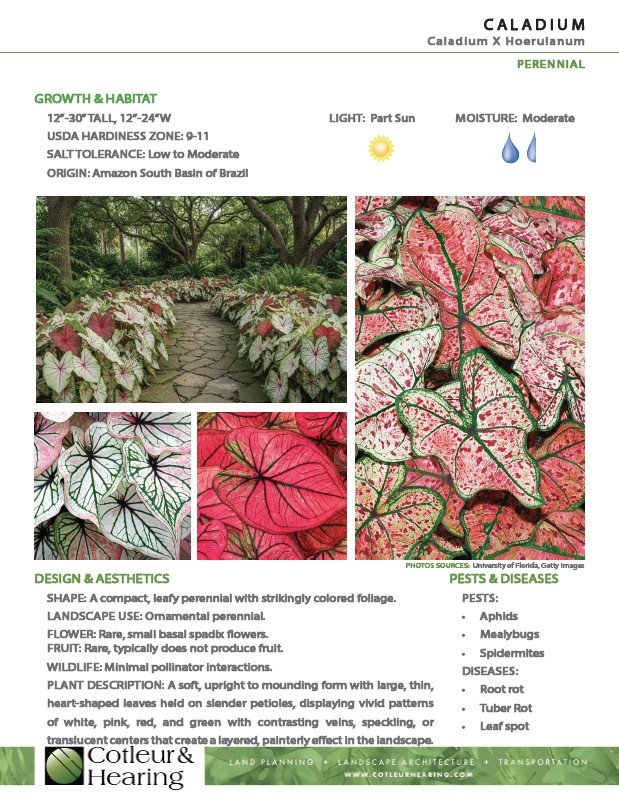
In the South Florida landscape, Caladium bicolor functions as a warm-season, tuberous perennial valued primarily for its large, heart-shaped foliage and dramatic color patterning rather than for flowers. The plant grows actively from spring through fall once soil temperatures consistently exceed about 70°F, producing upright to slightly arching leaves on slender petioles that typically reach 12 to 30 inches in height, depending on cultivar. Its foliage displays combinations of white, pink, red, and green, often with pronounced venation, mottling, or translucent centers that intensify in filtered light.
Caladiums perform best in South Florida’s humid climate when planted in partial shade and well-drained, organic-amended soils, where consistent moisture supports steady growth without promoting tuber rot. Although not salt tolerant and unsuitable for exposed coastal sites, they are well adapted to inland and protected landscapes with freshwater irrigation. As temperatures cool in late fall, caladiums naturally enter dormancy, with foliage declining and disappearing completely through winter. The underground tubers remain viable in the soil and reliably resprout in spring, making caladiums true perennials in zones 9 through 11, including Jupiter.
In landscape design, caladiums are commonly massed beneath palms, shade trees, and along building foundations to provide seasonal color and broad-leaf texture during the warm months. Because they are deciduous, they are often paired with evergreen shrubs or groundcovers that maintain structure during winter dormancy. Low maintenance requirements, strong heat tolerance, and predictable seasonal performance have made caladiums a staple foliage plant in South Florida residential and commercial landscapes.